
From St. Peter’s to the Hill
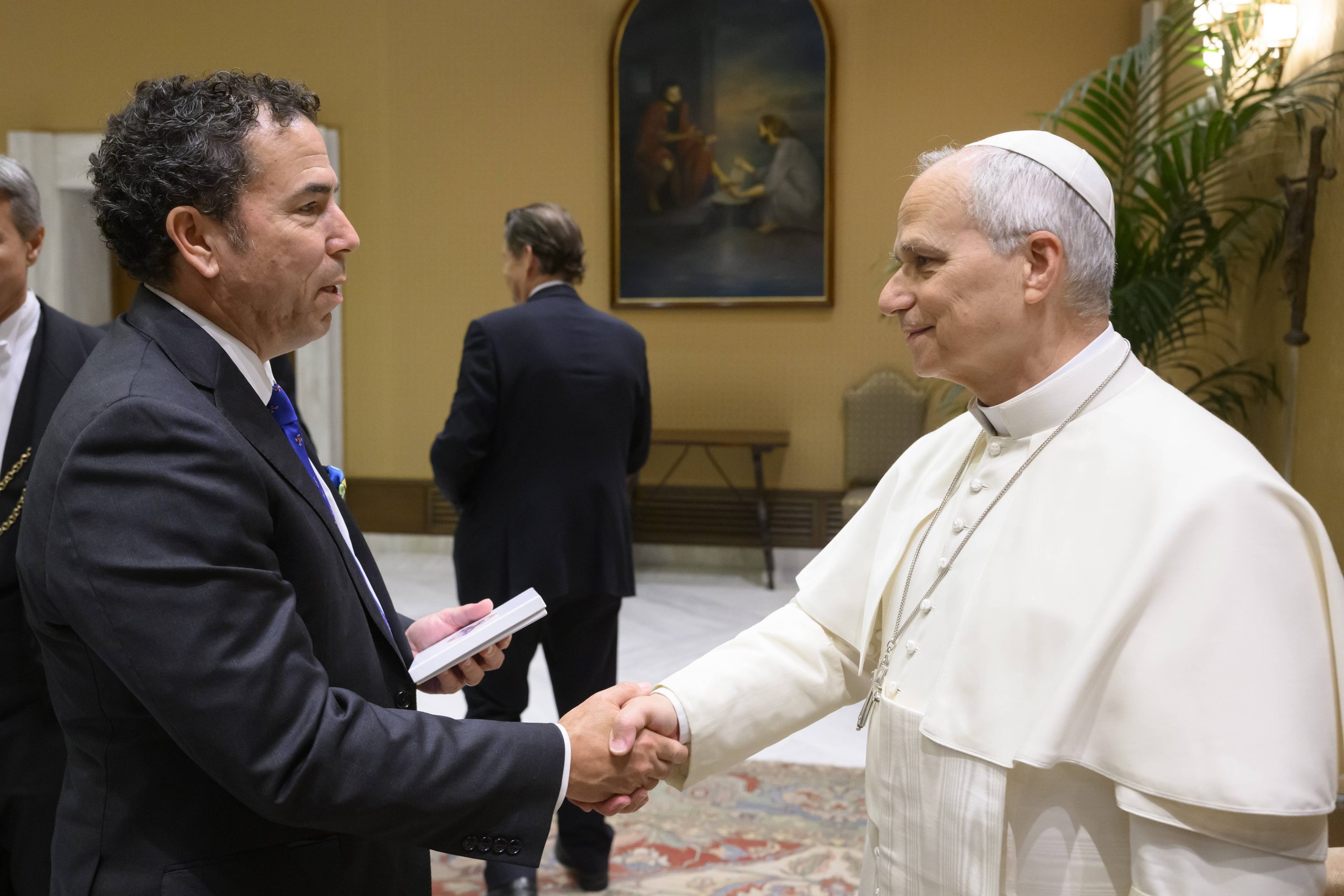
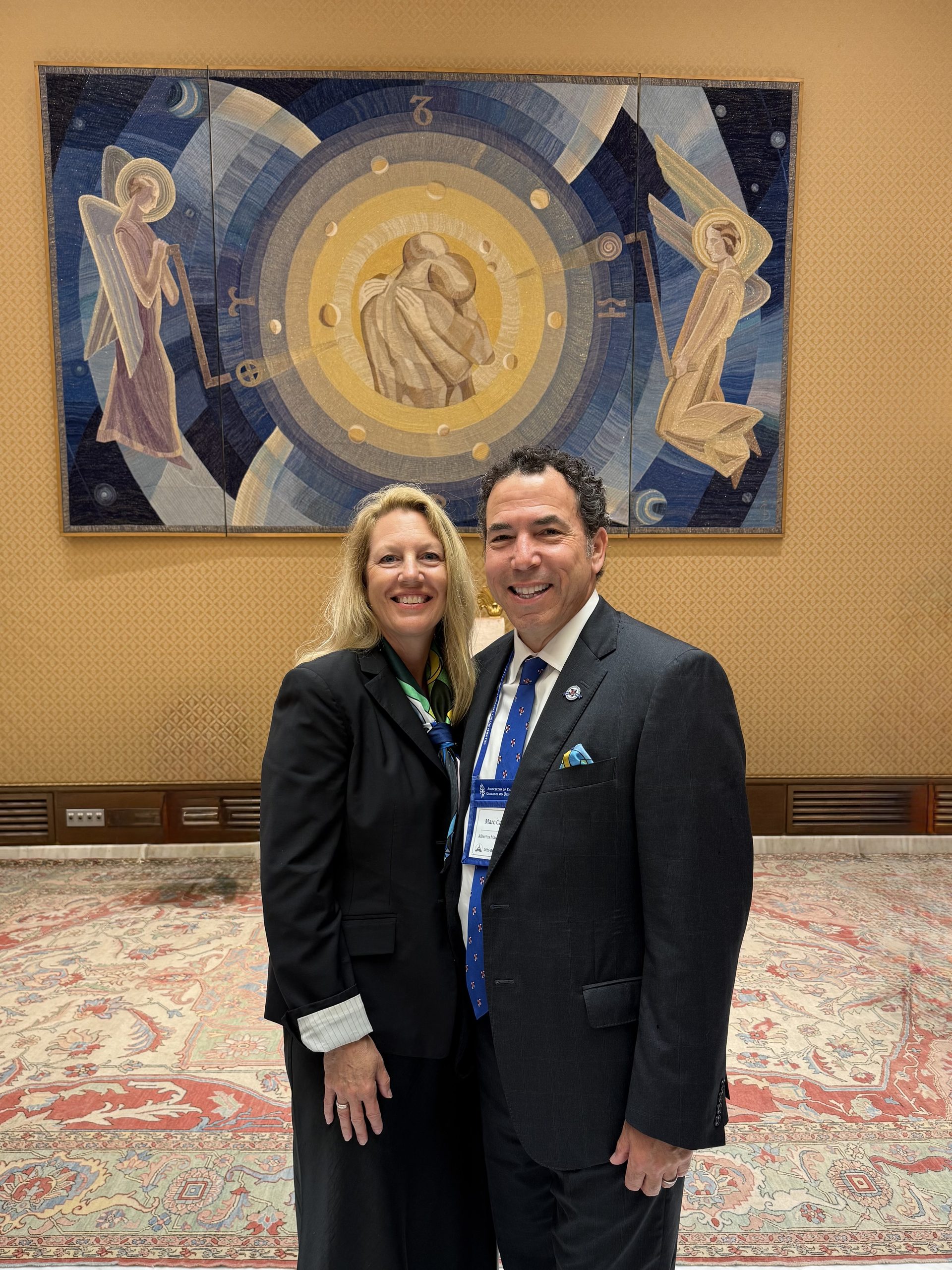
During Albertus Magnus College’s Centennial Year, President Marc M. Camille, Ed.D., and his wife, Rebecca Brogan Camille, Ph.D., professor of biology, traveled to Rome, representing Albertus as participants in the Association of Catholic Colleges and Universities’ (ACCU) Rome Seminar. What began as an unexpected invitation became a deeply meaningful pilgrimage through the history, faith, and Dominican tradition of the Catholic Church, and culminated in a private audience with the Holy Father, Pope Leo XIV.
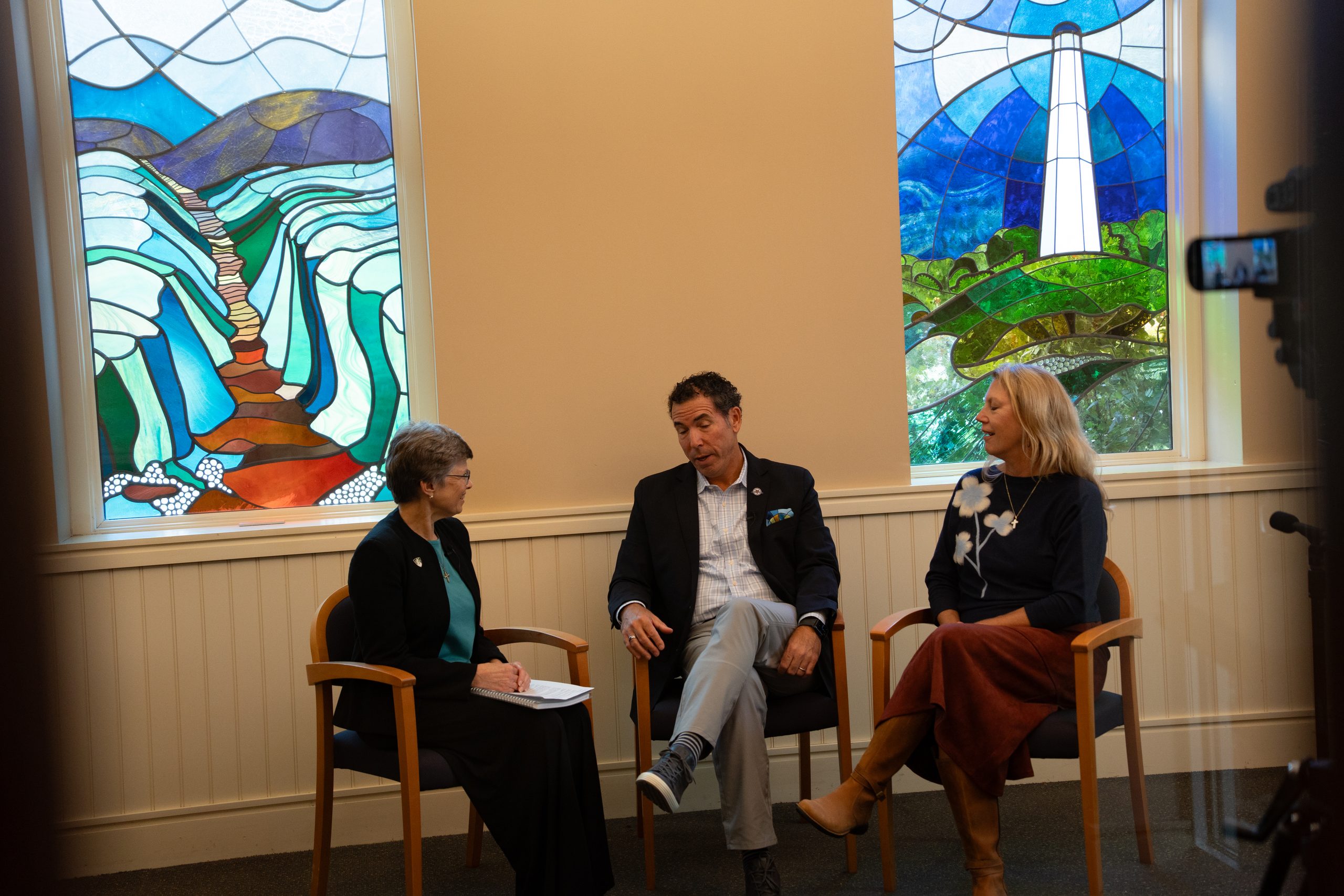
In this special conversation for From the Hill, Sr. Ellen Coates, O.P., Assistant to the President for Dominican Mission and Chief Mission Officer for Albertus, sat down with President Camille and Dr. Brogan Camille to discuss their experience and the ways they are bringing its lessons home to the College as it begins its second century.
SR. ELLEN COATES, O.P.: What made this trip to Rome possible, and what made it especially meaningful during Albertus’s Centennial Year?
President Marc M. Camille: The opportunity was completely unexpected. Dr. Donna Carroll, President of the ACCU and Albertus honorary degree recipient in 2024, extended the invitation for us to represent Albertus in the Rome Seminar. The Seminar is an immersive pilgrimage for our nation’s Catholic higher education presidents, a unique opportunity to experience the history of the Church and connect that history to the work of Catholic education today. When Dr. Carroll extended the invitation, she mentioned this year’s Seminar would include a private audience with the Holy Father. That certainly got our attention. And with the support of the College’s Board of Trustees, we were able to participate.
To do so in the midst of Albertus’s 100th anniversary year was particularly special. Neither Becky nor I had ever been to Italy, so everything was new. To find ourselves immersed in the history of Rome, the Church, the Vatican, and the Catholic tradition was simply aweinspiring. To culminate that experience with a private audience with Pope Leo was something neither of us ever imagined we would experience.
Dr. Rebecca Brogan Camille: It was beyond incredible. Having never been to Rome, everything was new and beautiful and meaningful. There were many moments when I thought, “Where am I? Is this really happening?” It was overwhelming in the best possible way.
SR. ELLEN: What message from Pope Leo has stayed with you since returning to Albertus?
Dr. Brogan Camille: One of the things I keep thinking about is his reminder that we have a responsibility, particularly as leaders in Catholic education and as teachers, to help the people we encounter. That has really stayed with me.
There are days when the work can feel challenging, but when I think back to that experience and his message, it gives me purpose and hope. I am so grateful that I was able to participate in that pilgrimage. It truly was life changing.
President Camille: I agree with Becky’s sentiments, and the timing of our audience with the Pope was also significant, if not serendipitous. Only a few weeks before, he issued his first encyclical, Magnifica Humanitas, addressing artificial intelligence and humanity in an era of rapid technological transformation.
A core theme from the encyclical, and very much present in the message he delivered to our delegation during the visit, was that Catholic institutions have both a responsibility and an opportunity to lead in this moment—to acknowledge and embrace artificial intelligence and technological innovation, but always to do so through the lens of our Catholic identity and values, focused on what it means to be human and to protect human dignity and promote human flourishing. That message has resonated deeply, and it’s one I’ve shared widely throughout the Albertus community.
SR. ELLEN: You have written about the importance of making education “intentionally human.” What does that mean for Albertus as we enter our second century?
President Camille: Artificial intelligence can appear remarkably human-like, but Pope Leo reminds us that one can only be human if one is, in fact, human. That distinction is increasingly important.
Our students are here to learn and to become. It would be easy to think of AI as a replacement for education rather than a tool that can enhance it. At Albertus, on behalf of our students, our faculty and staff are committed to utilizing AI as a means to deepened learning experiences and as an impetus for collaboration.
Dr. Brogan Camille: And that connects directly to our Dominican pillars, Community and Service, in particular, make education come alive. AI can help you write a paper, but it cannot replace the relationships, experiences, service, and human connections that form a person.
Ultimately, education is about more than preparing for a career. It is about becoming a person, a human, who can engage with others, contribute to a community, and serve the world.
SR. ELLEN: You also visited important Dominican sites in Rome. What did that experience mean to you?
President Camille: Yes, visiting Santa Sabina Basilica (the world headquarters for the Dominican Order) and Santa Maria sopra Minerva minor Basilica (with the tombs of Saint Catherine of Siena and Blessed Fra Angelico) were experiences that made the connection to the College’s Dominican charism and tradition. To visit these places was equally moving and educational. We were reminded that Albertus is part of a faith tradition that extends back more than 2,000 years and a charism tradition now more than eight centuries in the making.
Dr. Brogan Camille: Another amazing experience was our visit to St. Peter’s Basilica, during which we celebrated Mass below the Basilica, adjacent to the tomb of St. Peter. Walking down the dark, narrow stairs was a walk back in history, and then being together for Mass was an intimate and moving experience. I will never forget it.
SR. ELLEN: I have to ask you, what was it like to personally meet Pope Leo?
President Camille: This was the humbling experience. Becky and I kept asking ourselves leading up to the audience, and continue to do so, of “how did this possibly happen?” It’s just not something that either of us, in a million years, imagined might happen. But it did, and to do so representing Albertus was an absolute honor, a privilege.
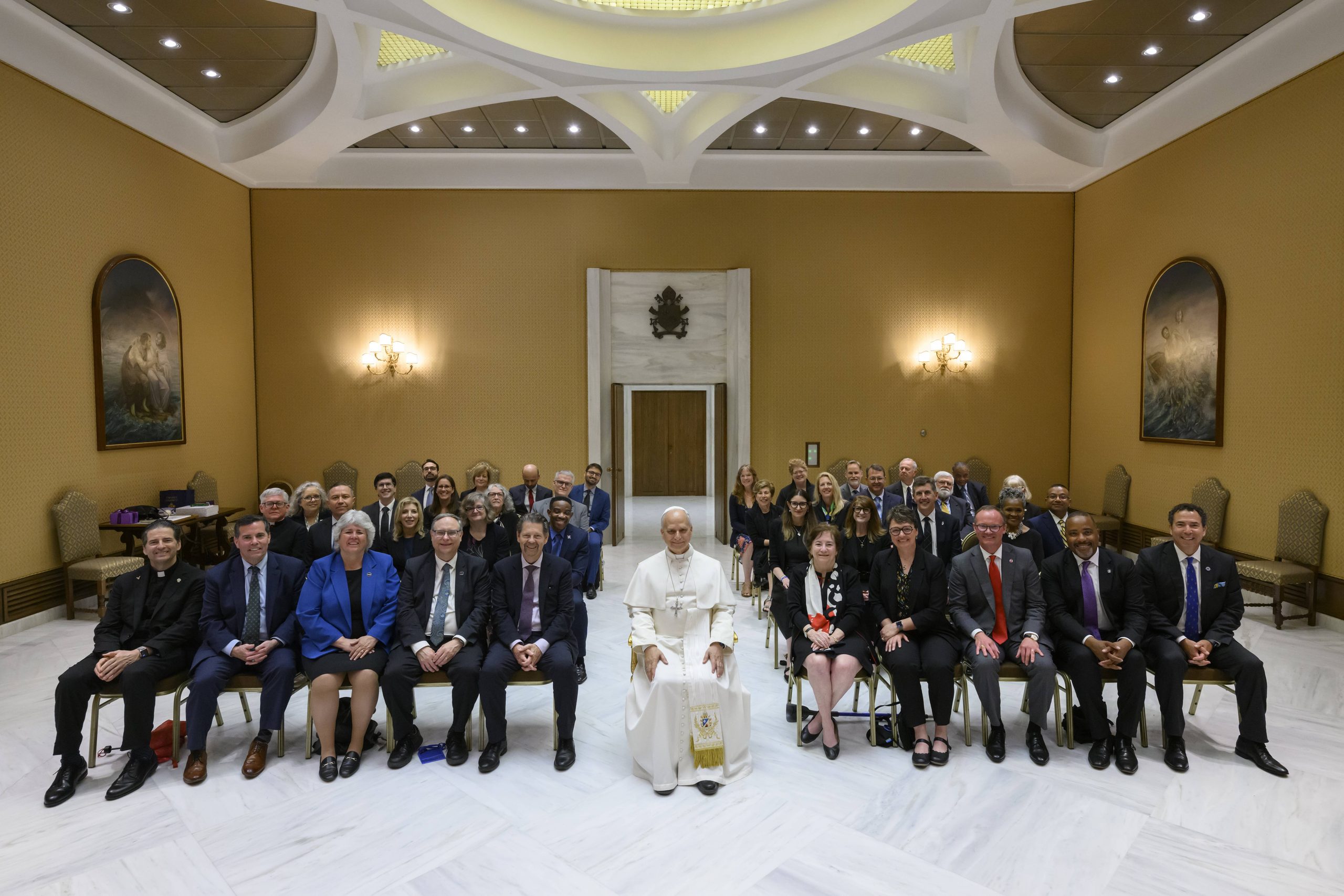
The private audience was the pinnacle experience. Our delegation was small, maybe 35 in total, and as we made the walk from our hotel to the Vatican that morning, it was the one time all week it rained. And rain it did, as we walked through Rome in our formal attire, huddled together under small umbrellas. But eventually, the Vatican gates opened, and we made our way to the building where we would be meeting with the Holy Father.
I remember that when Pope Leo entered the room, he was smiling and joyful. The formalities included his welcome and address to us, and be blessed our delegation and the communities we serve. Then each of us had an opportunity to greet him personally.
In all candor, I had stressed about the possibility of meeting the Pope, what it would be like and what I might say. I kept coming back to how taken I was by his first words after he had been elected Pope, when he appeared on the balcony overlooking St. Peter’s Square and shared, “Peace be with all of you.” When it was my turn, as he extended his hand to mine, I said, “Holy Father, it’s an honor to meet you, and may peace be with you.” He made me feel welcomed and affirmed.
I went on to introduce myself as president of Albertus Magnus College and shared that we were celebrating our Centennial Year. On behalf of the Albertus community, I presented him with a small ceramic tile I purchased in a previous visit to the Prouilhe Monastery in France; the tile was hand-painted by a Dominican Nun, and on it was her vision of St. Dominic.
Dr. Brogan Camille: When I met Pope Leo, I told him, “It’s a pleasure to meet you, Holy Father. Thank you for all you do to lead us in peace.” I also shared that I was one of the teachers he had spoken about in his address and that I would carry his message back with me.
He had a very calming presence. Afterward, I went back to my seat and basically collapsed!
SR. ELLEN: What do you hope our diverse Albertus community takes from Pope Leo’s message?
President Camille: I think the simplest message is that he is with and for them—that everyone is welcome. And that he wishes for them peace and love. Our diverse student body is one of Albertus’s greatest gifts. I often claim we practice radical hospitality at Albertus, where everyone is welcome at our table.
SR. ELLEN: Finally, how will you turn this experience into action at Albertus?
Dr. Brogan Camille: We came home more hopeful and more faith-filled. The experience reminded us that what we are doing here matters. Our students are not simply preparing for the future— they will help shape it.
President Camille: The timing is remarkable. We are beginning Albertus’s second century focused on the future, and at the same time Pope Leo is challenging us to think deeply about a future shaped by AI and technology, never losing site of what it means to be human and to foster human flourishing. This is our shared calling and purpose.
The newly opened Ditkoff Immersive Learning Collaboratory is a wonderful example of how we can embrace technological transformation on behalf of our students—not to replace human learning, but to further ignite intellectual curiosity and deeper engagement in the learning process.
We also are working on plans for March 2027, hoping to convene at Albertus presidents from Catholic colleges and universities, to discuss how as education leaders, we can embrace AI and technological transformation through the lens of humancenteredness.
I believe Albertus is distinctively positioned to contribute in this timely, essential dialogue.
SR. ELLEN: And perhaps that is the most fitting lesson to bring home from Rome: that after 100 years, Albertus is still being called to look forward and lead—with faith, purpose, community, and hope.